
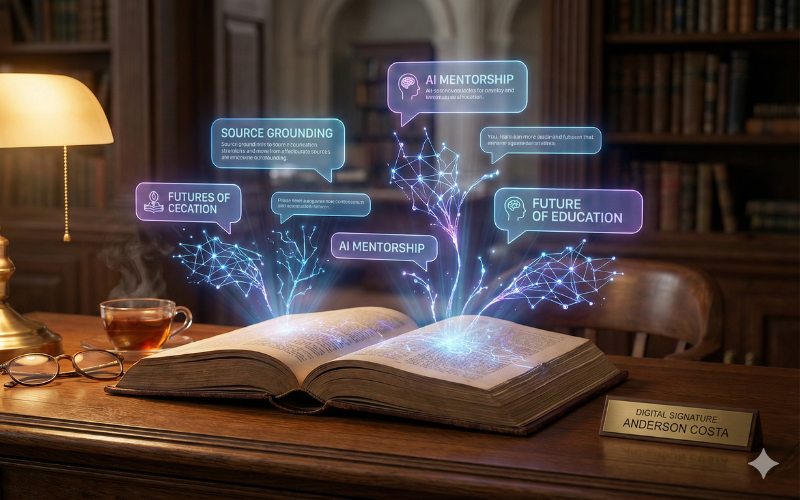
Have you ever felt that subtle paralysis when staring at a folder full of downloaded PDFs or a virtual shelf stacked with eBooks you bought but never found the time to study deeply?
For centuries, learning meant adapting to the book. For the first time, this dynamic is starting to reverse.
There is a Japanese term for piling up unread books: Tsundoku. But in 2026, the problem isn't just a lack of time; it's the inefficiency of the method. For years, we were conditioned to believe that generative AI was merely a "hallucination" tool creative, sure, but unreliable for serious study. That narrative is now obsolete.
The true silent revolution we are witnessing is called Source Grounding. Tools like Google's NotebookLM have changed the game by allowing AI to answer not based on "everything on the internet," but strictly based on the documents you provide. Imagine transforming that dense technical manual into a tireless mentor that speaks your language, answers specific queries, and generates instant summaries. We are no longer talking about "reading" a book; we are talking about dialoguing with knowledge. It is the end of passive reading and the dawn of active content absorption.
Language barriers and technical complexity have always been the gatekeepers preventing access to cutting-edge knowledge. How many times have you skipped excellent material because the terminology was too dense or because mental translation consumed all your cognitive energy? With this technology, the game changes.
A good book in English, Spanish, or French stops being an obstacle and becomes just… content.
By uploading your materials to a controlled AI environment, you create a private learning instance. The system analyzes the structure, understands the context, and stands ready to be interrogated.
Technical Flexibility and Practice
The flexibility of this model is impressive and adapts to any market niche. Let's take a technical scenario, for example. Say you need to master modern software architectures. Instead of linearly reading 500 pages of documentation, you can ask the AI to explain how to implement secure microservices. If your focus is diving deep into specific hard skills, like building robust APIs, the system can extract and explain only the relevant code snippets from dense material on .NET Core APIs, saving hours of manual searching.
Precision in Health and Science
But the application isn't restricted to code and hard sciences. The "intelligence" of these systems shines equally in biological and health fields, where precision is non-negotiable. For professionals who need to keep up with the latest clinical research, such as advanced hair treatments, it is possible to upload multiple scientific papers and ask for correlations between them. Imagine studying complex health topics and hair therapies with the help of an assistant that has already read and organized the entire Trichology Guide for you, highlighting only what is clinically relevant.
Soft Skills and Human Development
Furthermore, we cannot ignore personal development and soft skills. Often, books on behavior and leadership are read and quickly forgotten. By interacting with the text, you retain more. If your goal is to bulletproof your mind against the pressure of the modern corporate environment, you can turn a bestseller on emotional intelligence into a practical workshop, extracting exercises on Resilience in IT applicable to your daily routine.
Democratic Accessibility
What makes all of this viable today is accessibility. In the past, having a personal tutor or access to simultaneous translation of technical materials was an expensive privilege.
It’s not a future promise. It’s accessible now.
Today, with the evolution of models like the Gemini Pro Promo, this technology is available, often for free or at a marginal cost, democratizing access to "super-learning." The barrier is no longer financial or linguistic; it is merely behavioral. The question isn't whether you should use AI to study, but why you would still be studying as if it were 2010.
The transition from a passive consumer of information to an active architect of one's own knowledge is the major competitive differentiator of this decade. Source Grounding tools give us the capacity to curate, interrogate, and apply information with a speed that traditional biological reading could never achieve.
The book hasn’t become obsolete. It has finally gained a voice.
By adopting these technologies, you aren't "cheating" at learning; you are optimizing data processing to free your brain for what it does best: critical thinking and creation.
The future belongs to those who know how to ask their data the right questions. To continue exploring these frontiers of technology and receive insights that go beyond the obvious, I invite you to follow the discussions on Canal Nexa. And, of course, for those looking to build their study setup or acquire the best reads with financial intelligence, the best flash deals are available daily at Seleção Vip. Knowledge is served.